The Sacred Canopy Initiative

The forest was here before the church.

It has been praying the whole time. We are asking congregations to walk in and take their place.

Look at what you have.

Not what you could build. Not what a grant might fund. What is already there, on the land the church has held for decades or centuries, waiting to be recognized for what it is.

In many cases, what is there is a forest. Or the edge of one. Or a stand of trees old enough to have been there before the building. Or a hillside no one has touched because no one knew what to do with it.

We are asking churches to name that land as sacred. To enter it intentionally. To walk it with the liturgical seriousness they bring to any other act of worship. And, where the land has been cleared or degraded, to plant it back into what it was.

This is the Sacred Canopy Initiative.

Church forests of Ethiopia.

In the highlands of Ethiopia, the last remaining patches of ancient forest survive inside the walls of Orthodox Christian churches. The surrounding landscape was cleared for agriculture generations ago. The church forests survived because they were understood as sacred. Holiness was the conservation strategy. What belonged to God was not touched.

Those forests are now among the most biodiverse places on the continent. Birds, insects, mammals, and plant communities that exist nowhere else in the region persist inside church walls. Not because of a conservation program. Because of theology.

The Sacred Canopy Initiative begins from the same premise: that the church's land is sacred not primarily because the church owns it, but because God was present in it before the church arrived, and has never left.

The initiative meets churches where they are.

Churches differ in what they have. The initiative takes two forms accordingly.

The Sacred Grove

For smaller properties and urban sites. A ring of native trees, densely planted in the Miyawaki method, around a central clearing with simple seating. The clearing is the sanctuary. The forest holds the congregation.

The grove can be established on a side yard, a parking strip, a corner of the property that has been lawn for decades. Within five years there is genuine canopy. Within ten, the clearing feels enclosed, ancient, dimensionally different from the street outside.

The Sacred Loop

For properties with existing forest, hillside, or natural land. Not a labyrinth imposed on the landscape, but the loop the land already made: a path that enters the forest, moves through it, arrives at water or overlook or clearing, and returns.

The stations along the route are placed where the land already offers something: a change in canopy, a view, a descent, a place where water moves or gathers.

Both forms rest on the same theology. The forest is not a backdrop for human prayer. It is a fellow worshiper. The walker enters an assembly that has been in continuous praise since before the first human arrived.

The garden precedes everything.

Eden precedes the Temple, precedes Babel, precedes the rebuilt wall of Nehemiah. The garden is the original form of sacred space. It is not a place humans made for God. It is the place God made for humans to learn how to be creatures: to tend and to keep, which in Hebrew carries the sense of watchful presence, of a guardian who stays close to what is loved.

The church forest is the return of sacred ground to its first vocation.

Read the full essay →

The same ground holds every season.

The Sacred Canopy Initiative is not a program that runs alongside the church's liturgical life. It is woven into it.

Season of Creation

September / October. Planting season. The congregation plants together. The act of putting native roots into ground is the liturgy.

Rogation Days

Spring, before Ascension. Tending and blessing. A procession through the planting, blessing of soil and seed and the mycorrhizal work happening in the dark below the path.

Lent

The Stations of the Cross walk the forest in its winter form. Bare, structural, the geometry of branches. The cross was wood. A tree gave its body.

Easter

The Stations of the Resurrection walk the same ground as it wakes. Resurrection is not only a theological claim. It is a biological event happening in the canopy above the path.

Pentecost through Labor Day

The Stations of the Spirit walk the forest at full canopy. Shade, birdsong, the deep summer work of photosynthesis.

Advent

The Stations of Hope. Dormancy as preparation, the seed in cold ground, the long dark before the light. The forest in December is their physical form.

Epiphany

The Stations of Inspiration, one per week. Revelation in unexpected places. The forest in January is an unexpected place.

The shade belongs to those who live under it.

A sacred grove in a canopied suburb, without a justice dimension, is a wealthy parish amenity. The initiative refuses that limitation from the beginning.

Environmental racism produces heat islands. In neighborhoods with little tree canopy, summer temperatures run eight to twelve degrees higher than in tree-canopied communities a few miles away. Those neighborhoods did not choose their condition. The relationship between tree canopy and race in American cities is structural — the material legacy of redlining, disinvestment, and a century of decisions about who deserves shade.

Churches in canopied communities can sponsor canopy in heat-burdened neighborhoods. Not as charity. As creaturely solidarity. The shade belongs to the community that lives under it, regardless of who plants the trees.

The forest teaches the economics before the church has to argue them. Abundance moves toward need. It has been moving that way under the path the whole time.

St. John's, Cold Spring Harbor.

St. John's Episcopal Church holds fourteen acres of water, eleven acres of forest, and a meditation garden at the threshold between them.

A stone grotto marks the threshold where the cultivated garden gives way to the wild hillside above. From the grotto, a path enters eleven acres of forest, rises along the hillside above the pond, and descends to the water's edge. The loop returns through the forest to the garden. The full walk is approximately one mile.

At the bottom of the loop: St. John's Pond. Fourteen acres, owned by the parish since 1831. Fed by Cold Spring Brook. Home to osprey, river otter, hooded mergansers, alewife (Alosa pseudoharengus), and American eel. The 1682 earthen dam at its outlet has held this water for three and a half centuries.

The walker enters through a memorial garden. Passes through a stone grotto. Ascends through ancient forest. Descends to living water. Returns.

This is not a pilgrimage route that was designed. It is one that was discovered. The land made it. The parish is learning to walk what was already there.
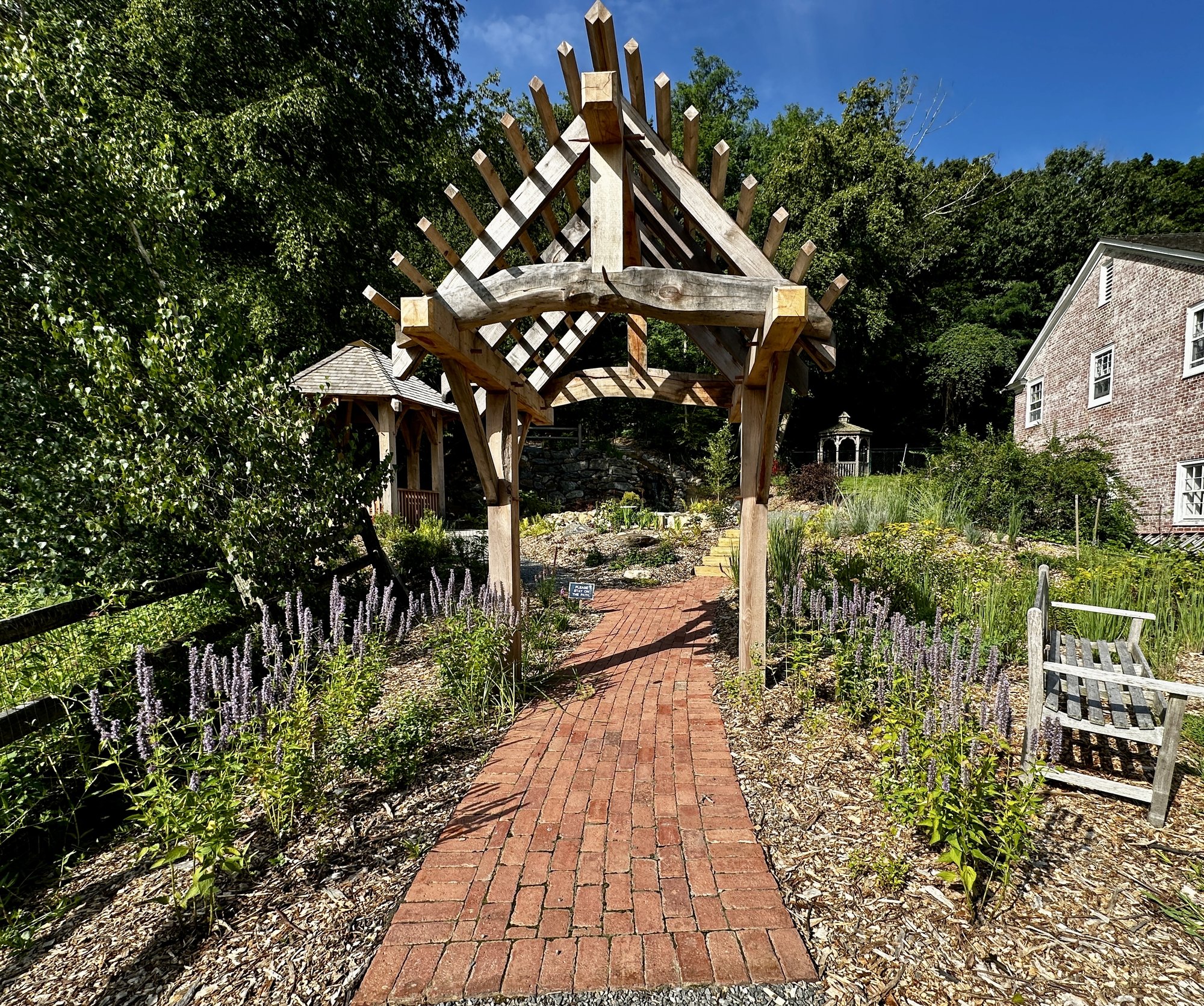
The stone grotto at St. John's, Cold Spring Harbor — where the garden gives way to the hillside
The stone grotto at St. John's — where the garden gives way to the hillside. Photo: St. John's Episcopal Church.

We are not asking churches to build something they don't have.

We are asking them to see what they do.

What forest is on your property that has not been named as sacred? What loop does your land already make? What stand of trees is old enough to have been worshiping before the building was erected?

If you have it, name it. Mark the threshold. Walk it with intention. Let the liturgical year move through it.

If you don't have it, plant it. Dense, vertical, self-organizing. The Miyawaki method works on a side yard. It works in a parking lot corner. It works wherever there is ground and the willingness to let something return.

And then find a partner church in a neighborhood without shade, and plant there too.

The canopy does not belong only to the places that already have it.

Join the Coalition →