I. The Forest Inside the Wall
From the air, the northern highlands of Ethiopia read as a single brown expanse. Terraced slopes. Ridgelines scraped to rock. Fields worked so long and so hard that the soil itself has begun to leave. And then, scattered across the brown like coins thrown on a table, dark green circles. Each one holds a church at its center. Each one is a forest.
Come down out of the air and stand at the edge of one. The line between the field and the forest is a wall, sometimes stone, sometimes only the understanding of a boundary that everyone here has kept for longer than anyone can name. Cross it. The temperature drops. The light goes from white glare to green shade. Above you the canopy closes. Juniperus procera, the tall African pencil cedar. Wild olive, Olea europaea subspecies cuspidata, gnarled and dark. Podocarpus falcatus holding its old height. Birds you did not hear in the fields are loud in here. Something moves in the leaf litter. The ground is soft with what the trees have dropped and made and dropped again.
At the center is the church. Round, in the old Ethiopian way, its inner sanctuary hidden behind a curtain. The forest is not the churchyard. The forest is the vesture of the church. The building wears the trees.
These are the church forests of the Ethiopian Orthodox Tewahedo Church, and there are thousands of them, most only a few acres, some no larger than the shadow of the building at their heart. They are the last of something. The highlands were forested once. Centuries of plow and axe and grazing took the rest. What survived, survived inside the walls, and it survived for one reason. It was understood as holy. To cut a tree from the ground around the church was counted a sin. The forest was not managed into permanence. It was prayed into permanence. Holiness was the conservation strategy, and it worked where every other strategy in the region failed.
Foresters who study these places — Alemayehu Wassie Eshete in Ethiopia, Margaret "Meg" Lowman and others from outside — describe them as refuges, islands of native highland forest that hold species the surrounding landscape has lost. Some of what grows and nests and burrows inside these walls persists nowhere else nearby. The forests are not intact. Cattle press at their edges. Drought presses at all of it. But they are here, and they are here because a people decided, and kept deciding across sixteen centuries, that the ground around the place of worship belonged to God and would not be touched.
Ethiopia is among the oldest Christian nations on earth. The Aksumite king Ezana was baptized in the fourth century, around the year 330, making the Ethiopian church among the oldest on earth. So the church forests are old the way the faith there is old. They have been kept sacred for as long as there has been a church in that ground to keep them.
I want to begin here, before any argument, because the argument is already standing in front of us with its roots in the soil. The church forest is not an illustration of a theological claim. It is the claim. It says that when a people treat ground as holy, the ground answers. It says that the forest and the faith have always been one long practice. It says the trees were worshiping before the wall went up, and the wall was built to protect the worship.
Everything that follows is an attempt to catch up to what the church forest already knows.
II. The Garden Precedes Everything
Open the Bible and the first thing God makes for the human is not a temple. It is a garden.
Eden precedes everything. It precedes the tabernacle in the wilderness. It precedes Solomon's temple and its cedar and gold. It precedes Babel, that first architecture of human ambition, and it precedes the rebuilt wall of Nehemiah and the second temple and every stone the tradition would later call sacred. Before there is a house for God there is a garden for the creature, and the creature is placed in it and given work.
The work is named in two Hebrew words. Abad and shamar. We translate them "to till and to keep," or "to work and to guard," or in older Bibles "to dress it and to keep it." But shamar is a rich word. It is the word for a watchman keeping the night. It is the word in the priestly blessing, the Lord bless you and keep you. It is the guardian who stays close to what is loved and does not let harm come to it. The first human vocation is not to rule the garden and not to improve the garden. It is to watch over it the way God watches over us.
This matters because the tradition has spent a long time reading the first chapters of Genesis as a grant of ownership. Dominion. Subdue the earth. The words are there, and they have done real damage, cited across centuries to justify the plow and the mine and the clearcut as the fulfillment of a divine command. But dominion in Genesis 1 is spoken in the same breath that calls the human an image of God, and the God whose image the human bears is, three chapters into the story, a gardener who walks in the garden in the cool of the day. The dominion of an image-bearer is the dominion of the one imaged. It looks like tending. It looks like keeping watch. It looks like a walk in the evening among things you love and did not make.
The church forest is the return of sacred ground to its first vocation. The Ethiopian community that would not cut the trees around the church was not preserving a resource. It was keeping a garden. It was doing, without a theory of it, the oldest work the human was given. And when a congregation in New York or in Lagos or in Manila looks at the land it has held for a century and asks what is already there, waiting to be recognized, it is asking the Eden question. Not what can we build. What has been given to us to keep.
Thomas Berry wrote that the universe is a communion of subjects, not a collection of objects. Genesis says the same thing in narrative. The garden is a communion. The human is placed inside it as one member charged with the care of the others, and the fall, whatever else it is, is the moment the human decides to stop keeping and start seizing, to reach for the one thing withheld rather than tend the abundance given. Every ecological wound since is a variation on that reach. The healing, if there is healing, begins where the reach is reversed. It begins with hands that go back to keeping.
III. Repentance Is Turning
The Greek word the Gospels use for repentance is metanoia. A change of mind, yes, but more than an interior adjustment. The Hebrew underneath it, shuv, is plainer and more physical. To turn. To turn around. To turn back toward the thing you walked away from. The prophets use it for a whole people changing direction. Turn, and live.
Repentance is turning. This is the second thing the church forest teaches, and it is the hinge of the entire initiative.
We do not usually think of planting a tree as repentance. We think of repentance as something that happens in the chest, in the confession, in the quiet after. But the tradition has always known that turning is done with the body. You kneel. You fast. You walk to the place you wronged and you make it right. Repentance that never reaches the hands is not yet repentance. It is regret wearing repentance's clothes.
Consider how a forest is actually restored. There is a method developed by the Japanese botanist Akira Miyawaki that has spread across the world in the last few decades. You study the ground. You find out what the native plant community of this exact place would be, the trees and shrubs and understory that belong here by soil and rainfall and bioregion, the community that grew here before the clearing. Then you plant that community, densely, many species together, and you get out of the way. The planting is not a design imposed on the land. It is the land's own successional logic, restarted by hand and then released. Within five years there is canopy. Within ten the young forest closes over and begins to run itself, feeding and pruning and seeding without you.
This method is not ours, and we should say so plainly. Akira Miyawaki gave it to the world, and groups like SUGi and the Afforestt movement have carried it into cities on six continents, planting dense native forests in schoolyards and hospital grounds and reclaimed parking lots, measuring the survival rates and the return of the birds. The Sacred Canopy Initiative joins that work and gives thanks for it. What the church adds is not a better technique. It is a reason. The horticulture is already proven. The question this initiative asks is why a people who call a piece of ground holy would plant a forest on it, and what happens to them when they do.
The Miyawaki method is repentance with a shovel in it. It does not ask what we want the land to become. It asks what the land was, what it wants to return to, and it turns the ground back in that direction. We are not building a new thing. We are reversing an old wrong. We are undoing, as far as our hands can reach, the clearing that came before us, and then we are stepping back to let the ground finish the work we could only begin.
This is why the initiative plants real forests and not symbolic ones. A symbolic forest is a gesture. A real forest, planted in the native community and released to its own succession, is an act of turning that the land will carry forward for centuries after the people who planted it are gone. The repentance outlives the penitent. That is what makes it repentance and not performance. You will not see the closed canopy. Your grandchildren's grandchildren will walk under it. You turn the ground, and you trust the turning to the God who gives the growth.
Wendell Berry has spent a lifetime saying that the care of the earth is a practical and daily discipline, not a sentiment, and that a person who loves a place proves it by the condition of the soil. So is every congregation that has looked at a mown lawn or a cleared hillside and decided to give it back to what it was. Turn the ground.
IV. Creaturely Solidarity
Here is where the initiative parts company with a word the church has grown comfortable with. The word is stewardship.
The church forest suggests something else. In the church forest the human is late. The trees were there before the wall. The community that keeps the forest did not create it and could not recreate it if it were lost. The junipers are older than the oldest person praying under them. The proper posture inside the wall is not the posture of a manager surveying an estate. It is the posture of a student who has walked into a room where the conversation started long ago.
Humans are late arrivals. This is not a diminishment. It is a relief. It takes the impossible weight of management off our shoulders and puts us back in our actual place, which is the place of the youngest member of an ancient assembly. We came in near the end. The photosynthesis was invented without us. The soil was built without us, over ages, by organisms we are only beginning to understand. The rain and the rivers and the long slow breathing of the forests kept the planet livable for three and a half billion years before the first human drew breath. We did not steward any of that. We arrived into the middle of it, and it fed us, and it is feeding us now.
Robin Wall Kimmerer, a botanist and a member of the Potawatomi nation, has given the church a language for this that the church badly needed and had partly forgotten. She writes about the world as gift. The strawberries in the field are not a resource to be extracted. They are a gift given, and the only fitting response to a gift is gratitude and the return of gift. She writes about the grammar of animacy, the way her ancestral language grants a verb-life to things English freezes into objects. A bay is not a thing. A bay is a being, bay-ing, the way a person is person-ing. When you speak of the forest as alive, as a fellow, as a member of the assembly, you are not decorating a scientific fact with poetry. You are speaking a truth English is poorly built to carry and Genesis assumed from the first page.
Under the path the gift economy is literal. Merlin Sheldrake and the mycologists have shown us what is happening in the dark below our feet. The roots of the trees are laced together by fungi, threads finer than hair, running through the soil in networks so vast that a single teaspoon of forest floor holds miles of them. Through these networks the trees trade. Sugar moves one way, minerals and water the other. A tree with more than it needs feeds a tree with less. Signals of stress and attack run tree to tree along the fungal lines. The forest, below the path, is not a collection of individuals competing for light. It is a community sharing what it has, a gift economy older than money, older than language, running quietly under every walk we take.
This is what the initiative means by creaturely solidarity. Not stewardship, which keeps us above the creatures and in charge of them. Solidarity, which puts us among them, one member of a body, receiving the gift and passing it on. The mycorrhizal network is a picture of the church as the church is supposed to be. From each according to abundance. To each according to need. The trees have been keeping that commandment since before there was anyone to write it down.
Restoration, then, is not management. It is midwifery. The midwife does not make the child. The midwife attends a birth that is already happening, creates the conditions for it to go well, and receives what comes. We do not make the forest. We create the conditions and receive the forest as gift. The work goes better, always, when we remember which one of us is doing the making.
V. The Forest at Prayer
Now we can say the thing the church forest has been saying all along, the thing the whole initiative rests on. The forest is a fellow worshiper.
This is the claim that sounds like poetry and is meant as theology. The forest does not use the ground around the church for prayer. The forest is praying. It was praying before the church was built and it will pray after the building falls, and the congregation that gathers in the sacred grove or walks the sacred loop is not bringing worship to a silent place. It is joining a service already in progress.
Scripture says this more often than we let ourselves hear. The Psalms are full of it and we have trained ourselves to read it as metaphor. Let the trees of the wood sing for joy. Let the rivers clap their hands. The mountains and hills shall break forth into singing and all the trees of the field shall clap their hands. We treat these as figures of speech, a poet reaching for images. But the tradition that gave us these words did not think the praise of creation was a figure. It thought the human was one voice in a choir that included the whole of what God had made, and that the sun and the sea and the cedar had their own parts to sing, in their own registers, whether or not any human was there to hear.
Paul takes it further and darker. In Romans 8 he writes that the whole creation groans together in labor pains, waiting. Waiting for what. For the revealing of the children of God, for the redemption that will set creation itself free from its bondage to decay. The creation is not scenery for the human drama of salvation. The creation is a fellow sufferer and a fellow heir, groaning under the same fallenness, waiting for the same liberation, straining toward the same God. When the church forest holds its species inside the wall while the highland empties around it, that is the groaning of Romans 8 made visible. The forest is holding on. It is waiting. It is enduring the decay and reaching past it toward the freedom of the children of God.
And Revelation, at the very end, does not close the story in a temple. It closes it in a garden with a city in it. A river of the water of life, bright as crystal, flowing from the throne down the middle of the street. And on either side of the river the tree of life, bearing twelve kinds of fruit, and the leaves of the tree are for the healing of the nations. The Bible begins in a garden and ends in a garden, and the tree that stood in the middle of Eden stands again at the end of all things, healing what was broken. The whole arc of scripture is bracketed by trees. The forest is not a detour from the story of salvation. The forest is where the story starts and where it ends.
BlueGreen Theology names three modes in which creatures are related to God.1 The forest praises unselfconsciously, being what it was made to be, the juniper junipering, the water running downhill toward the sea, praise offered simply by existing faithfully as the creature it is. The human praises self-consciously, able to know that we praise, able also to refuse. And all of it strains together toward a fulfillment none of us has seen, the eschatological mode, the freedom Paul says the creation is waiting for. These are not a ladder with the human on top. They are three ways of being turned toward the same God. The forest's unselfconscious praise is not a lower rung we have climbed above. It is often purer than ours. The trees have never once refused to be what they were made to be. We refuse daily.
To walk into the sacred grove, then, or to follow the sacred loop down to the water and back, is to take a place in an assembly. Prayer in the forest is not the human bringing holiness to nature. It is the human, latecomer, learning the tune the forest has been singing the whole time, and joining in. This is why the initiative weaves the liturgical year through the same ground rather than running a program alongside it. The forest keeps Lent in its bare winter geometry. It keeps Easter in the green return of the leaf. It keeps Pentecost at full canopy and Advent in the seed asleep in cold soil. The church year is not imposed on the forest. The forest was already keeping it. We are learning to keep it with them.
VI. The Shade Belongs to Those Who Live Under It
A sacred grove in a leafy suburb, kept for the enjoyment of a comfortable parish, is an amenity. It is a nice thing a wealthy church has, like good coffee after the service. The initiative refuses this from the beginning, and it refuses it on theological grounds, not political ones.
Here is the ground. Tree canopy in American cities is not distributed by chance. It follows old lines, and the old lines are the lines of race and money. Neighborhoods that were redlined two and three generations ago, marked in red on the maps of the federal agencies that decided where public and private money would and would not flow, are the neighborhoods with the fewest trees today. The disinvestment was drawn on a map, and the map is still legible in the canopy. Where the money went, the trees are. Where the money was withheld, the pavement bakes.
And pavement bakes literally. Trees cool the ground beneath them by shade and by the water they breathe into the air. A neighborhood with a full canopy and a neighborhood with almost none, a few miles apart in the same city on the same summer afternoon, can differ in temperature by a wide margin. Researchers who overlaid the old redlining maps onto measured summer heat found the formerly redlined neighborhoods markedly hotter than the neighborhoods that got the investment, in some cities by many degrees. The people in the hot neighborhoods did not choose the heat. It was decided for them, on a map, before most of them were born. Who gets shade and who bakes is a question that was answered by policy, and the answer is still killing people in heat waves that the trees a few miles away are quietly preventing.
This is why the justice arm is not an add-on to the theology. It is the theology. If the forest is a fellow worshiper and the shade it makes is a gift, then shade withheld from a neighborhood is a gift stolen, and a church that plants a grove for its own comfort while the next community over bakes has misunderstood what it planted. Creaturely solidarity does not stop at the property line. The mycorrhizal network does not check whether the tree it feeds deserves feeding. It feeds the tree with less because the tree has less. That is the pattern written into the forest floor, and it is the pattern the church is supposed to read there and carry up into the street.
So the initiative is built with two hands from the start. A congregation plants on its own ground, and it finds a partner in a neighborhood the maps left without trees, and it plants there too. Not as charity, which keeps the giver above the receiver the way stewardship keeps the human above the forest. As solidarity, which puts them in the same body. The shade belongs to the people who live under it, whoever paid for the sapling. The canopy does not stay only in the places that already have it. If it does, it is not the canopy of Revelation, whose leaves are for the healing of the nations. It is only a nice thing a wealthy church has.
The forest teaches the economics before the church has to argue them. Abundance moves toward need. It has been moving that way under the path the whole time.
VII. The Water at the Bottom of the Loop
I have been describing church forests in the Ethiopian highlands and groves not yet planted in cities not yet named. Let me end with ground I know.
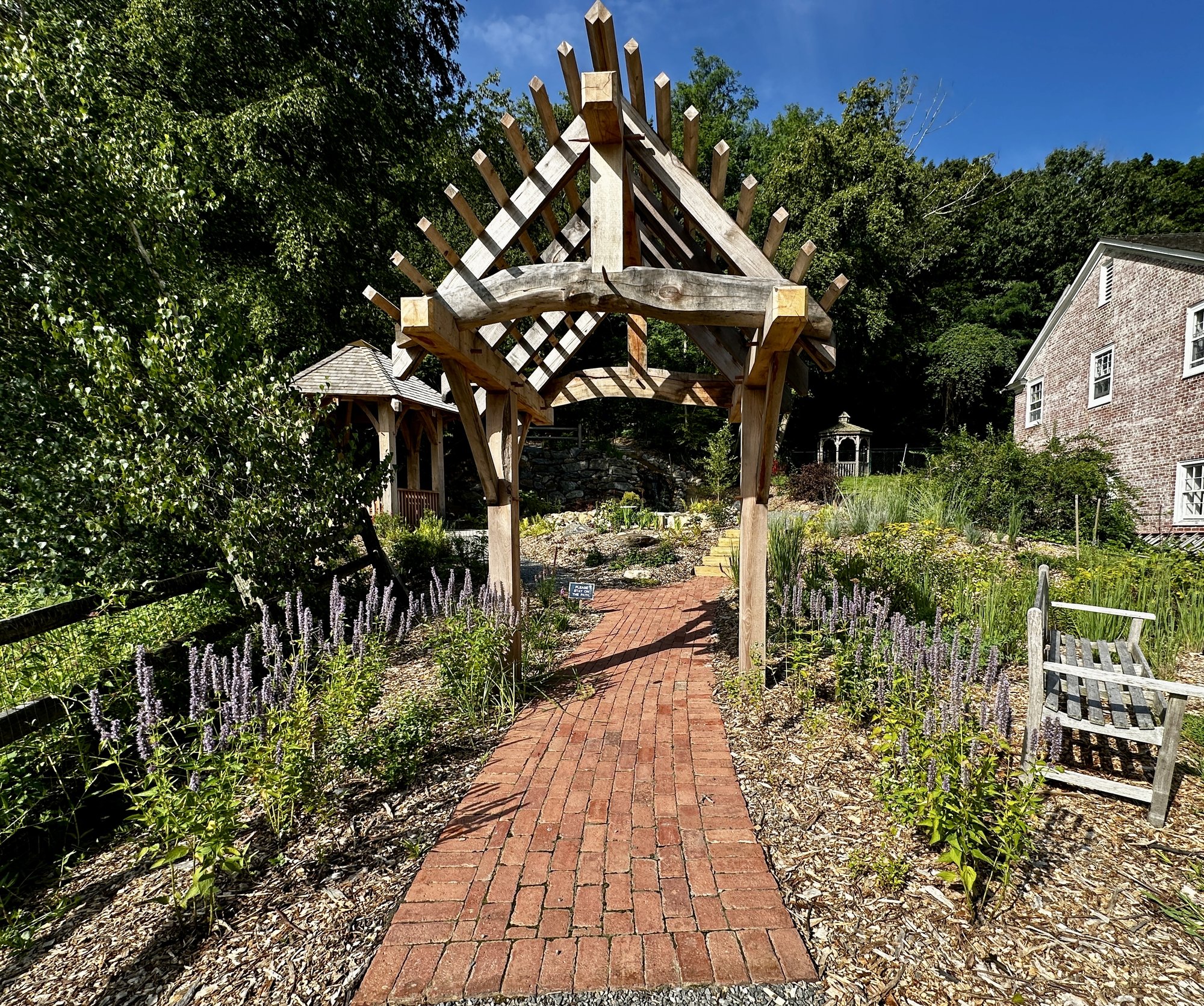
St. John's Episcopal Church in Cold Spring Harbor holds fourteen acres of water, eleven acres of forest, and a garden at the threshold between them. The garden was built for a woman named Irene Gubrud Finch, a teacher of meditation who loved this place and died suddenly in 2020. Her husband Steven, our Music Director Emeritus, asked that the garden be her memorial. The benches and the pavilions were made by a local artist, Steve Carillon, from the black walnut trees that had stood on that same ground. The wood did not leave when the trees came down. It became the thing that holds the people who sit now where the trees once stood. A woman is remembered in a garden made from the trees that grew where the garden is. That is the whole theology in one small place. Nothing is wasted. The gift keeps moving.
Water runs through the garden. A stone grotto marks the place where the tended ground gives way to the wild hillside. From the grotto a path climbs into the forest, rises along the ridge above the pond, and comes down to the water. At the bottom is St. John's Pond. Fourteen acres, held by the parish since 1831, fed by Cold Spring Brook, dammed by an earthen wall raised in 1682 that has held this water for more than three centuries. An osprey hunts the pond from the cross on the steeple. River otters work the banks. Hooded mergansers winter on the water. Alewife, Alosa pseudoharengus, run up the brook in spring, and the American eel goes the other way, down and out to a sea it will cross to spawn and die.
The walk is about a mile. It enters through a memorial garden. It passes a grotto. It climbs through old forest. It comes down to living water, and it returns.
No one designed this loop. The land made it, over centuries, and the parish is only now learning to walk it as what it is. St. John's will not be the first Sacred Canopy site. There is a dam to restore first, and a meadow to let come back. The first grove and the first loop of this initiative will be somewhere else, planted or discovered by a congregation that reads this and recognizes its own ground in it. We are still looking for that congregation. It may be yours.
But when the walker at St. John's comes down the last of the hill and the pond opens below through the trees, and the osprey drops off the cross and folds and hits the water and rises again with the day's catch bright in its feet, the walker is not looking at scenery. The walker has come down into the middle of a service that started long before the first stone of the church was laid, and will go on in some form long after the last stone falls. The alewife keeping the spring. The eel keeping the deep. The otter and the merganser and the old junipers on the ridge, each one being exactly what it was made to be, each one at prayer in its own register.
The Sacred Canopy Initiative exists because this ground cannot stay only in Cold Spring Harbor. It belongs wherever a congregation looks at the land it holds and asks what is already there, waiting to be recognized as sacred. If that question is live in your community, we want to hear from you.
The water was here first. It is still praising. The wall was built to keep the praise.
Come and take your place in it.
1 BlueGreen Theology describes three modes in which creatures participate in God. Unselfconscious participation: the creature praises by being fully what it was made to be, without self-reflection or distance — the juniper junipering, the river running downhill. Self-conscious participation: the human being, able to know that it praises, and able also to refuse. Eschatological fulfillment: the mode toward which all creation strains together, the freedom Paul names in Romans 8, when the groaning ends and the full praise of the new creation is released. These are not a hierarchy, with the human above the forest. They are three ways of being turned toward the same God. See Gideon L. K. Pollach, "Conscious and Unselfconscious: Human Uniqueness and Creation's Standing Before God," unpublished manuscript, St. John's Episcopal Church, Cold Spring Harbor, New York.
The Very Rev. Gideon L. K. Pollach is Rector of St. John's Episcopal Church in Cold Spring Harbor, New York, and the originator of BlueGreen Theology. bluegreentheology.org
Is that question live in your community?
Join the Coalition →